Introduction
This is quite an untypical post for my blog. Instead of writing about tech, I want to talk about my favorite YouTuber in the context of web development: Kevin Powell.
It feels like a good opportunity because his channel recently hit 1 million subscribers. What an achievement, and well deserved in my opinion! 🎉
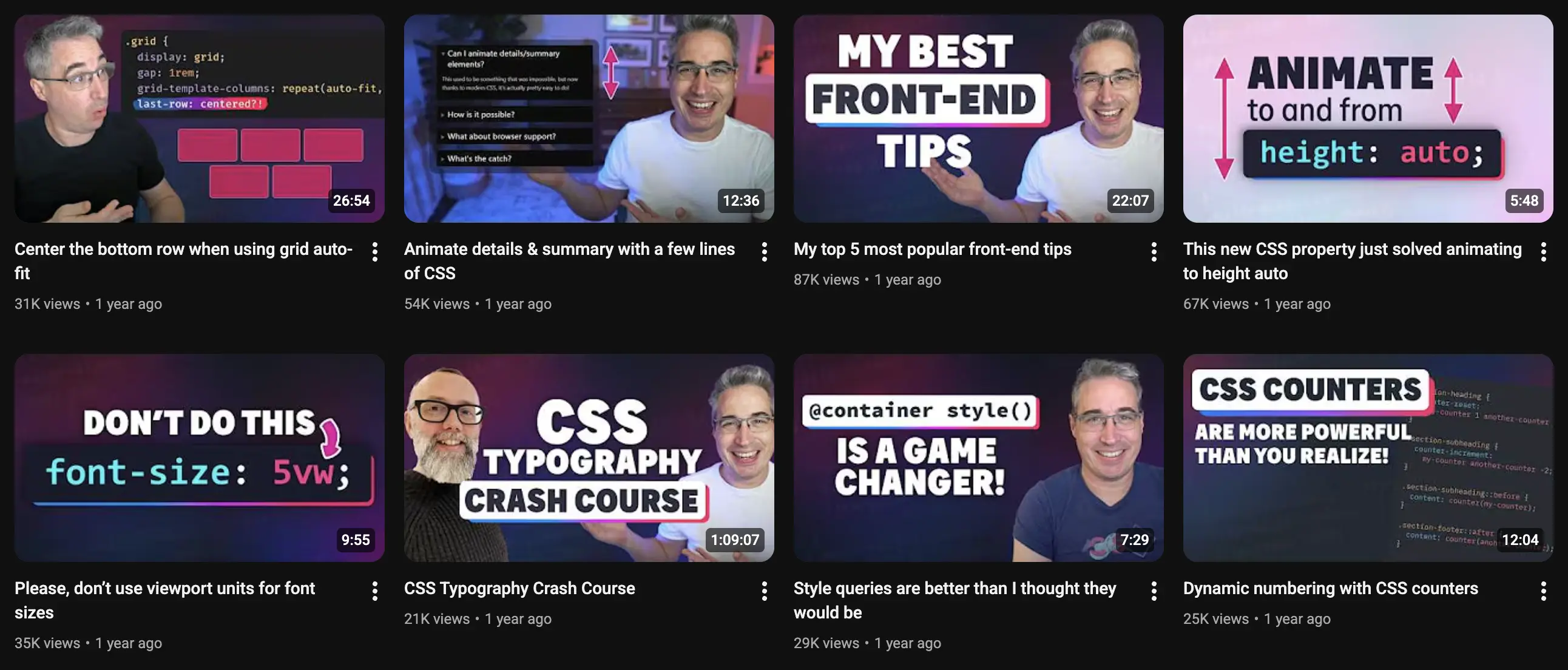
In case you don't know him: Kevin Powell is a web developer from Canada. His YouTube channel is devoted to CSS, the language that helps make websites look pretty, or as Kevin puts it at the end of every video: it makes your corner of the internet just a little bit more awesome. He has been creating videos for almost 10 years, and nowadays he is a full-time CSS educator.
This blog post is basically me admitting that I am a huge fanboy. I would probably feel more comfortable writing this post on Bluesky or some other messaging platform, mainly because it is just a bunch of personal opinions, but I'm afraid the post is simply too long for that.
What I like about Kevin's videos
I made my first websites around the year 2000. Back then, it was inline styles and presentational elements (<font>, <center>, etc.) all the way. I only started learning modern web development in 2019, in particular CSS. Around that time I also subscribed to Kevin's channel. Through his videos I developed a solid understanding of CSS, not just the basics, but also many advanced features. Also, I stayed up to date with the newest additions to the language.
While many of his videos cover basic building blocks of websites and how to make them look good, Kevin also explores (what I would call) creative CSS, such as animated gradients, 3-dimensional CSS, complex text effects, CSS battles, and much more.
Kevin doesn't just explain how a CSS feature works. He also talks about its advantages, possible downsides, and his own thoughts about it. He compares it to other features and puts everything into context. You can be pretty sure to learn something new, even if you have already been using that feature for a long time. I have never seen another YouTube channel about web development do this at the same level. This is what makes Kevin's channel stand out.
I really like that most of his videos go into depth. This does not necessarily apply to YouTube Shorts, which Kevin has also been making for a while now. Honestly, I wish YouTube had never added this feature to their platform (visit Instagram or TikTok if your attention span is gone!), but that's a different topic.
The pacing varies from video to video, but usually I find it great. Kevin takes the time to explain things properly. Sometimes he also makes impromptu videos where he tries to recreate a design or component live with CSS. These are of course much slower, but you learn a lot about his thought process while solving a problem.
In these videos he also includes failed attempts sometimes. That's just part of software development, so why not show it? Even in scripted videos he occasionally gets spontaneous ideas and tries them out. So the videos are never 100% fixed scripts, and I find that makes them more entertaining.
In my videos I have noticed the same thing: while recording, you sometimes gain a different perspective and even come up with a better solution than the one you prepared beforehand, even if your initial goal was to record what you already know.
Even though it is partly the nature of CSS itself, Kevin has an exceptional eye for detail, and he teaches that mindset in his videos. I think I have adopted this as well. I like to spend lots of time trying to make something look really good.
In a similar vein, Kevin did not jump on the “Ship fast with AI and make money” bandwagon. He clearly enjoys writing code (CSS in particular) by hand and polishing designs and components. I also think Kevin actively teaches this way of working, focusing on details and understanding what is happening. That resonates with me a lot (probably also because of my background as a pure mathematician).
Given my experience with Tailwind, I appreciate that Kevin still writes regular CSS (sometimes Sass). I won't repeat what I wrote in the linked post, but to keep it short: CSS is already good, and we don't need to add a leaky abstraction layer on top of it, especially one that introduces maintainability issues. After learning CSS properly, I believe you won't feel much need to use a CSS framework in the first place.
Accessibility should be the norm in web development, but unfortunately it isn't. So it is worth mentioning that accessibility is regularly addressed in Kevin's videos. It is not treated as an afterthought but as part of the regular development process. I think this is the right approach.
In his videos, Kevin usually talks about CSS features that make your life easier. Most of the content is what I would call positive content. The recent video Build modals in minutes with the dialog element is a perfect example.
Unfortunately, the same cannot be said about many other YouTube channels. In recent years it has become increasingly common to use stupid clickbait titles like “XYZ is dead” or “Do NOT use XYZ”, even when XYZ is a perfectly valid feature (cough Matt Pocock cough). Often the video itself tells a much more nuanced story.
I really dislike this trend. It's just for the clicks (sometimes it is also the result of incompetence). Kevin occasionally uses clickbait titles too, but that's basically my only criticism for the channel.
Kevin has also introduced me to other CSS experts, in particular Zoran Jambor and Amit Sheen. You should definitely follow them as well!
What I like about Kevin
Besides being a valuable resource for learning CSS, Kevin's videos are simply fun to watch. I think a big part of that is his personality (as far as I can tell through the internet).
He is clearly passionate about CSS and web development in general. And that passion seems to be contagious. It makes you want to keep watching and learning. You can count on Kevin starting every video with a big smile, greeting you as your fellow frontend friend. He also keeps a positive attitude when solving problems, even when he gets stuck.
And as mentioned earlier, the videos are not just about “getting the CSS done as fast as possible” (cough Tailwind cough), but about taking the time to understand what is happening in detail, and that resonates with me a lot.
Kevin also comes across as a very humble person. He does not brag about his (vast) knowledge on CSS or his YouTube success. He openly admits when he does not understand something, especially during live coding sessions.
You could see this again during the livestream when his channel hit 1 million subscribers. Many YouTubers would have made a huge spectacle out of it. Kevin noticed the number, said “cool”, smiled, and then continued with a casual Q&A. What a nice, down-to-earth guy!
Unsurprisingly, he also politely rejected the title “King of CSS” that some people gave him a few years ago. If you ask me, that title should go to Temani Afif.
I'm also writing this post because there are so many YouTubers out there who are the exact opposite. They show off, constantly put themselves above others, and would LOVE to be called “the king of XYZ”. At some point they stop appearing like normal people and become full-time influencers.
Kevin is definitely a CSS influencer, but I'm very glad he has not adopted the typical influencer personality.
Coding tutorials on YouTube
The reality of coding tutorials on YouTube is that views have been declining rapidly in recent years. I think almost every channel is experiencing this (mine as well, although it's small anyway). Brad Traversy discussed this topic in the video Why I stopped making coding tutorials, which you definitely should give a watch.
Kevin's channel shows the same pattern. Even with 1 million subscribers, a typical video today might get around 30k views, even after several months. And the trend seems to be getting worse.
There are several theories about what is happening. One explanation is that the pandemic pushed many people into web development, and now after a few years they have moved on to other interests or jobs. Another explanation is that LLMs now write much of the code for people. Developers think they no longer need someone explaining CSS, especially those who just want to “get the CSS done”. And finally, people's attention spans have become shorter (thanks TikTok!). Many viewers are no longer used to watching longer YouTube videos.
Personally, I still enjoy watching coding tutorials. Learning CSS can be fun, particularly when Kevin is the instructor. Learning the fundamentals also makes you a better developer. And at least at the time of writing, LLMs are never fully up to date with the latest CSS features. They also often produce redundant or outdated CSS declarations. I don't like the idea that this kind of CSS gets shipped without a proper human developer reviewing it.